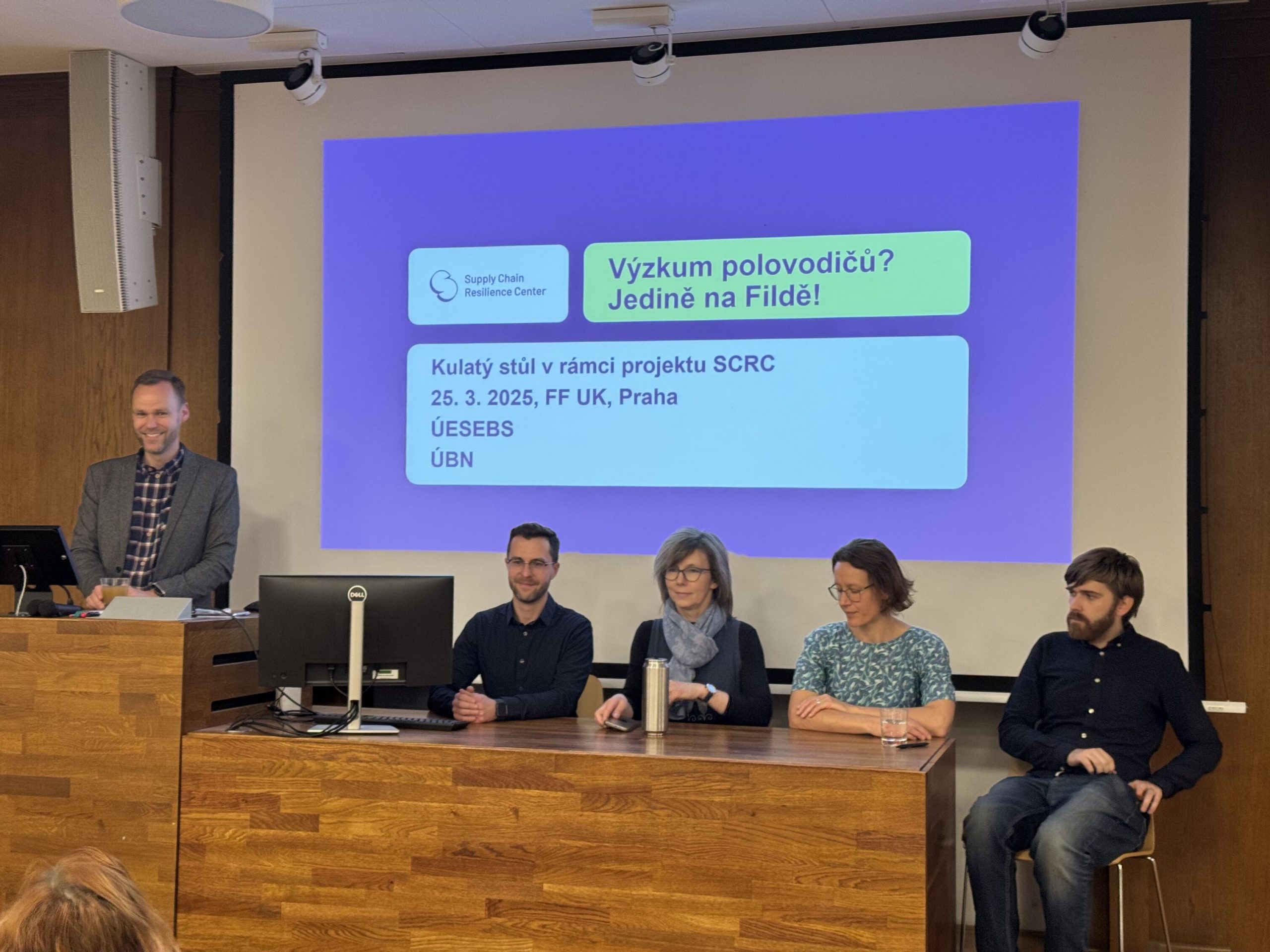
On March 25, 2026, an event took place at the Faculty of Arts of Charles University as part of the SCRC project, focusing on the potential integration of anthropological and linguistic approaches in the study of semiconductors and supply chains. The event was open to all students and staff of the Faculty of Arts interested in expanding their knowledge beyond their usual fields of specialization.
The round table was organized by members of SCRC: Dr. Adam Horálek, Bc. Marek Veverka, and Dr. Sandra Kreisslová from the Institute of Ethnology and Central European and Balkan Studies, and Dr. Adrian Zasina, Dr. Andrea Hudousková, and Dr. Svatava Škodová from the Institute of Czech Language for Foreigners and Deaf Studies. The discussion was moderated by Dr. Sandra Kreisslová, a member of the team.
In the opening session, Dr. Horálek introduced the focus of SCRC and placed its work within the broader context of Czech-Taiwanese relations. He also explained the importance of the semiconductor industry in the current geopolitical landscape and highlighted the role of the Taiwanese company TSMC in relation to supply chain resilience. He outlined the main objectives of the ethnological-linguistic team within the SCRC project.
This was followed by a presentation from the linguistic team, which focused on resilience and the image of Taiwan in Czech online media. The typology of the media environment and the data sources derived from a monitoring corpus of the Czech internet were briefly introduced. The linguistic research employed statistical and collocational analyses to track changes in media discourse using corpus linguistics methods. Covering the period from 2017 to the end of 2025, the findings showed both an increasing volume of coverage about Taiwan and a shifting representation over time. The most frequent collocations indicate growing interest among Taiwanese investors in relocating business activities to distant territories due to rising tensions between China and Taiwan, alongside more frequent discussions of supply chain resilience and semiconductor security.
The ethnological team’s presentation followed, building on the topic of semiconductor security and focusing on sharing best practices from ethnographic research in a corporate environment. It began by emphasizing the challenges related to the specific nature of the research field and associated ethical issues. Interviews conducted with representatives of various companies connected to the semiconductor industry in the Czech Republic identified two main domains in which Czech industry plays a crucial role. The first is the production of semiconductors used in electron microscopes, a sector in which the Czech Republic accounts for one-third of global output. The second is the defense industry, where the Czech Republic has a long-standing tradition and ranks as the 18th largest defense producer worldwide. Ensuring security within supply chains therefore depends significantly on maintaining technological advantage and recognizing the dual-use nature of innovations.
The subsequent discussion focused on the prospects of Czech industry in the semiconductor sector and on the evolving situation in Czech media, where topics such as supply chain sustainability, cybersecurity, and the role of semiconductors in the development of artificial intelligence technologies are appearing with increasing frequency.